If the car detects the fault itself, what is left for the mechanic to do?
Dino Collazzo
AI is bringing predictive maintenance to the automotive industry, analysing data and signals from the vehicle to anticipate faults. But identifying an anomaly does not yet mean knowing how to address it: the mechanic’s role is shifting from ‘finding the problem’ to deciding how to fix it
The role of artificial intelligence in the automotive industry is no longer merely an emerging technology. From design and production right through to after-sales support and maintenance, AI is reshaping processes, skills and business models across the entire automotive supply chain. For major vehicle manufacturers and their supply chain – from OEM (Original Equipment Manufacturers) to the IAM (Independent Aftermarket) sector and right through to the garage sector – artificial intelligence is an operational lever for gaining a competitive edge and securing profit margins.
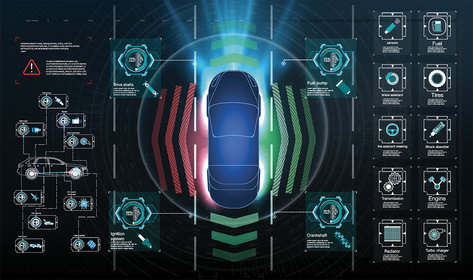
In fact, according to the Deloitte 2025 Manufacturing Industry Outlook, AI currently represents the technology with the highest potential return on investment for manufacturing companies. For the automotive sector, the use of artificial intelligence in industrial processes and in the final product would result in greater operational efficiency (cost reduction and supply chain optimisation), shorter design and testing times, and vehicles with high added value. Today’s cars are already, to a large extent, ‘computers on wheels’. But the real leap forward could come from artificial intelligence integrated directly into the vehicle. This is where an increasing share of the competition is playing out: from computer vision, which enables autonomous driving systems to interpret what is happening around the car, to next-generation ADAS, right through to natural language processing, which transforms traditional voice commands into a natural dialogue with the AI assistant. But artificial intelligence could change not only the way we drive, but also the way we repair our cars. One of the most interesting developments concerns predictive diagnostics. Connected directly to the control unit, artificial intelligence can continuously analyse the data collected by the sensors and monitor the vehicle’s condition. It would therefore not merely report a fault that has already occurred, but could recognise an anomaly, assess its severity and priority, and indicate what might happen if action is not taken in time. For the car repairer, the change would be anything but minor. Software capable of connecting the vehicle to the workshop would enable a shift from a ‘fix the fault’ model to one based on ‘preventing the fault’. The difference is substantial.
A tyre fitter, bodywork specialist or mechatronics technician who receives an early warning can order the spare part, schedule the work and prepare to tackle the problem even before the car arrives at the workshop. Work thus becomes more organised, timely and, at least in the long run, more efficient. This does not mean, however, that the repairer can simply rely on the car’s own diagnosis. The vehicle will still need to be checked in the workshop. What will change most is the way in which this check is carried out: increasingly intelligent in-car systems will be able to collect and interpret the data produced by the sensors, transforming it into useful information for the technician. The result could be a fully-fledged diagnostic report, setting out the possible causes of the malfunction and the solutions to be considered. And this is where the most sensitive question arises: if the car can identify a problem, diagnose it and communicate it directly to a smart workshop, what role is left for the mechanic? Probably much more than one might think. Predictive diagnostics can automate part of the work, namely the identification of the symptom. But it does not eliminate the need to decide how to proceed.
Setting priorities, choosing the sequence of operations, identifying the most suitable spare part and, above all, understanding whether a repair is truly necessary will continue to require expertise, experience and the ability to assess the situation. AI, therefore, may not take work away from the car repairer. Rather, it could shift the focus of their work: less time spent searching for the problem, more time spent deciding how to fix it.