


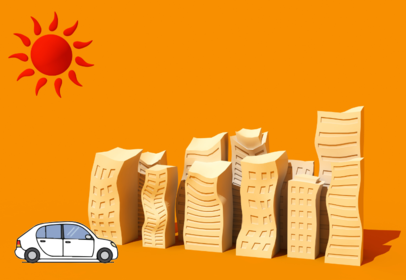
White cars and urban heat islands: light-colored paint keeps the air cooler
Chiara Casagrande
Lecce, Malaga, Santorini, and Cadiz. In addition to making us long for summer, these four Mediterranean cities have something else in common: they are almost completely white. Their geographical location, which means that their surfaces are exposed to prolonged and intense sunlight, has forced these urban centers to come up with innovative solutions. What if it wasn't just the surfaces of buildings that were white, but also cars?
The research team at the University of Lisbon, which presented a study published in City and Environment Interactions, asked itself this very question and found that white cars do indeed heat the air less.
After all, as every art history lesson worth its salt teaches us, black absorbs all colors, while white reflects them. Scientifically speaking, what we are referring to is albedo, defined as the ratio between the amount of light reflected by a body and the amount of light it receives, i.e., the reflective capacity of a surface.
The experiment
Two insulated cars, one white and one black, were parked on asphalt at around 8 a.m. on July 23, 2024, side by side, and remained exposed to the sun for over 5 hours.
The measurements, recorded between 1:40 p.m. and 2:12 p.m., show interesting differences in the air temperature around the two cars: dark-colored vehicles can increase the air temperature near the surface by up to 3.8 °C compared to the adjacent asphalt, while light-colored vehicles often produce lower temperature anomalies.
Cars are made of different materials than those used in the construction of buildings and roads, and during daytime exposure, their metal surfaces heat up very quickly. On the other hand, asphalt, thanks to its higher thermal mass, heats up much more slowly. This means that a car can become very hot in a short time, while the surrounding road surface remains fairly cool. The same cannot be said for the surrounding air, however.
Urban heat islands
Among the climatic effects found in cities and most widely studied is that of urban heat islands (UHI), thermal anomalies caused by various interrelated factors, originating from alterations made by humans to the characteristics of the city's surface.
Two main types of variables contribute to determining the temperature of a heat island: those that cannot be controlled and those that can be mitigated. The former include factors that we could define as natural, such as the geographical location of the city itself, weather conditions such as wind speed and cloud cover, the summer season, the night-time period and changes in local wind patterns. Controllable, mitigable variables include human interventions, such as the definition of urban geometry and conformation, the presence of green areas, and the thermal and radiative properties of the types of materials used in construction.
These fixed anthropogenic alterations, referred to in literature as urban forms, are then added to dynamic activities, urban functions, to constitute anthropogenic heat, i.e., the thermal energy released directly by human activities into the environment: energy consumption, use of water resources, air pollution, industrial processes, and, of course, traffic, understood as the movement of vehicles.
It is therefore easy to understand the importance of the choice of materials and colors that make up urban surfaces in mitigating the temperature of a given city. In Los Angeles, for example, where heat waves are increasingly constant and maximum temperatures reach 47 degrees, the streets have been painted white since 2017. There is a special whitish emulsion called ‘CoolSeal’ that does not absorb light rays but reflects them, lowering the temperature of the asphalt by at least ten degrees.
Considerations:
The question to ask, then, is: what would happen if the findings of the University of Lisbon researchers were applied to urban planning strategies for reducing heat islands?
First of all, the study showed that it is possible to “estimate the impact of the material and thermal properties of cars on an urban scale by examining the space they occupy on the ground, especially when they are stationary.” The trend is that in the morning and evening, cars are distributed in low-density neighborhoods, while during the day they are parked in the city center.
“The daily movement of over 700,000 vehicles on Lisbon's road network and their stationary occupation of up to 10% of the road surface in the city center cause significant daytime changes in the overall albedo of the surface. [...] Consequently, from a heat management perspective, light-colored vehicles are preferable, as their impact is lower.”
In terms of urban planning, action can be taken by considering color-based parking regulations in heat-sensitive areas, encouraging the use of reflective coatings, promoting shading structures in outdoor parking lots, planting trees along roads and enhancing green infrastructure, providing for the use of white vehicle fleets for centrally managed administrative activities, and supporting private individuals in the purchase of white vehicles or in the process of coating those already in their possession.
The automotive aftermarket sector, which has always been attentive to sustainability issues, has the opportunity to play a key role in these planning strategies by proposing innovative solutions that can contribute to the creation of paints and painting cycles geared towards greater reflectance and the creation of films/wraps and reversible solutions for fleets.
Bibliography:
Matias, M., Mills, G., Silva, T., Girotti, C., & Lopes, A. (2025). The underestimated impact of parked cars in urban warming. City and Environment Interactions, 100232.
https://doi.org/10.1016/j.cacint.2025.100232
Sottana, M. (2012). Experimental analysis of the “heat island” phenomenon in the city of Padua [Unpublished master's thesis]. University of Padua.
